How the General Manager Model Actually Works
A general manager is responsible for the overall result of a clearly bounded business inside a larger organization. That business might be a geography, product, customer segment, or business line with its own profit-and-loss (P&L) statement. Often described as a mini-CEO, the GM sets the goal, owns the plan and tradeoffs, and coordinates work across product, operations, marketing, finance, analytics, and partnerships.
Companies often respond to a stalled product, a slow-growing geography, or conflict between functions by naming a GM and hoping the role fixes the problem.
The model is useful when a business is large and cross-functional enough that no single function can manage it alone. Giving one person responsibility for the whole can restore focus and speed. That only works if the person can control the work behind the goal.
AI is making general-management skills useful beyond formal GM roles.
One capable operator can now do more of the research, analysis, design, marketing, support, and software. The harder choices remain: which customer to serve, which bets to make, how the economics should work, and where to spend the next week.
Inside a large company, a GM makes those choices across functions. A solo founder makes all of them. Product management has been documented, debated, and turned into an industry. General management has received far less attention.
This post is for anyone who is a GM, wants to become one, or is helping an organization decide whether to adopt the model.
I was a GM at DoorDash from 2019 to 2021, where I learned much of what I know about the model from Tony Xu and Christopher Payne. Since then, I have advised dozens of companies on the model, working with CEOs, COOs, board members, and other leaders at companies including Block and AngelList.
The title is the easy part. The job works only when one person has a coherent business to run, a measurable outcome, committed support across functions, and authority to make the decisions the plan requires.
The failures I see are usually preventable, and they tend to show up in five places.
The rest of this piece is about how to address each one.
Before You Appoint a GM
If you are considering a GM model, answer these five questions in writing:
- Is there a coherent business that actually needs a GM? The unit should have a clear boundary, distinct customers or economics, several meaningful levers, and enough cross-functional complexity to justify one owner. If the GM will own a P&L, define its boundaries here.
- Can you define success with one long-term outcome and clear guardrails? Leadership should agree on the target, with finance validating the economics and analytics validating the baseline and measurement. Neither team should be asked to bless a number after an executive has already announced it.
- Will the GM have committed partners and capacity? Name the finance and analytics support, along with the product, engineering, design, operations, marketing, sales, and partnerships capacity the plan requires. A GM should not spend the job cleaning data or lobbying for every hour of functional help.
- Which decisions can the GM actually make? Be explicit about pricing, priorities, partnerships, operations, and budget. Be equally explicit about what remains central.
- What happens when priorities collide? Define the shared goals, review cadence, executive sponsor, and escalation path before the first real conflict.
If those answers are vague, I would not appoint the GM yet. Fix the model first.
Give the GM a Real Business to Own
The first decision is where the GM’s business begins and ends. A GM cannot own “growth” or “customer experience” in the abstract. The boundary needs to be specific enough for one person to own the result while still fitting within the parent company’s strategy and constraints.
The role becomes useful when functional ownership starts to break down. Marketing can hit its acquisition target while the product loses users. Product can ship its roadmap while unit economics get worse. Operations can improve quality while costs make the business impossible to scale. Each function can make a sensible decision while the business loses.
The GM owns the combined result.
General Motors faced this problem in 1920. William Durant had assembled GM from a sprawling collection of carmakers and parts suppliers. The businesses could move independently, but headquarters could not reliably compare their performance, control inventory, or decide where the next dollar of capital should go. GM’s 1922 annual report documents the resulting inventory crisis. The loose federation no longer worked.
Alfred Sloan’s organization plan, formally adopted in late 1920 and effective in January 1921, kept operating decisions in the divisions while defining how those divisions related to headquarters. The main car divisions were organized by brand and product line, not geography or individual model: Chevrolet, Oakland, Oldsmobile, Buick, and Cadillac.
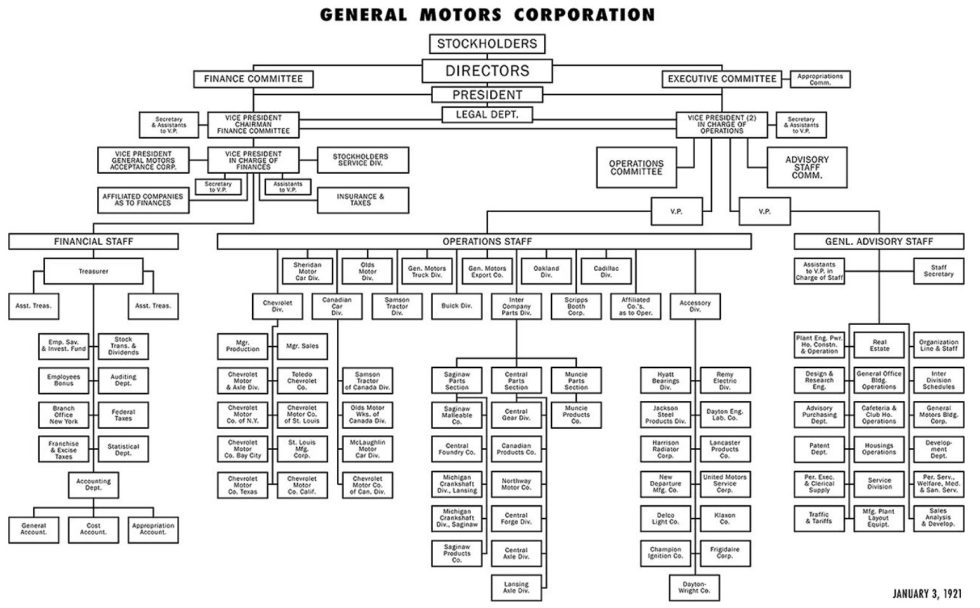
GM’s organization plan, adopted January 1921 (source)
Each division had its own engineering, manufacturing, and sales functions. A general manager or divisional president was responsible for its performance. Over the next several years, GM gave the brands distinct price positions, turning businesses that had often competed with one another into a more coordinated portfolio.
By the mid-1920s, division heads had broad operating authority. Headquarters set company and product policy, controlled cash, approved major capital commitments, required common accounting and forecasting, and compared divisions on profit and return on investment. Committees coordinated engineering, purchasing, and sales across divisions.
Retail created the same need at a different level. Imagine Walmart trying to manage an enormous assortment from the center. Senior leadership can decide the company’s strategy, but it cannot give sustained attention to every department and category. Who is waking up every day thinking about each one?
In Sam Walton: Made in America, Walton described Walmart’s “Store Within a Store” system. Department heads were treated as managers of their own businesses, with visibility into the cost of goods, freight costs, profit margins, and how their department ranked against the same department in other stores. This was not a modern category GM with a chain-wide P&L. It did push information and accountability toward the people closest to the work.
Now apply the same logic to a category. Take patio furniture as a hypothetical example. Someone needs to integrate the decisions about selection, inventory, pricing, and promotion because each one changes the economics of the others. Someone also has to react when a wet spring ruins the original forecast. Putting one person in charge gives those choices a common goal and economic model.
Amazon applied a similar logic as it grew from books into many categories. An Amazon category leader owns growth across multiple functions and is explicitly described as the general manager of the business.
Tech companies now draw these boundaries in different ways.
Intuit has EVP/GMs for its Consumer, Small Business and Mid-Market, and Services groups.
The geographic model is one I know firsthand: I was the first New York City GM at Caviar from 2015 to 2017. Across ridesharing, food delivery, and other fast-growing categories of the 2010s, putting a GM in each market became a core organizational choice for ambitious companies expanding city by city. Like Caviar, Uber’s early city GMs were responsible for growth, marketing, operations, rider and driver support, supply, and service quality.
At DoorDash, I saw the model expand beyond city-level ownership. Tony’s 2026 shareholder letter explains why that matters: each part of the business has its own objective, and managing those goals in isolation “could be a disaster.” Someone has to coordinate them around the customer.
DoorDash describes Strategy & Operations as developing and executing strategy for new geographies and products while working across functions. That is how I learned to think about the GM role there: one person is accountable for how the functions work together inside a defined business. DoorDash does this without reporting each business as its own financial segment. Its 2025 10-K says the company has one reportable segment, with the CEO reviewing financial performance on a consolidated basis.
At Robinhood, the boundary is the business line. In 2022, the company reorganized into a GM structure, placing product teams within businesses whose GMs had broad responsibility. A later SEC response identified the initial businesses as Brokerage, Crypto, Say, and Cash, and its 2025 annual report says it remains organized around GMs. Christopher Payne, one of the people I learned from at DoorDash, joined Robinhood’s board in December 2024, after the reorganization was already in place.
These companies use GMs to own categories, business lines, or geographies. Scale alone, however, does not create a need for GMs.
Apple is a useful counterexample. When Steve Jobs returned, he dismantled the business-unit structure, put Apple under one P&L, and organized it by function. The company instead aligned important decisions with deep functional expertise.
Some companies work better without business units. If a company’s advantage depends on tightly integrated technology, design, and functional expertise, splitting it into separate businesses can make coordination worse. A good GM unit has distinct customers, economics, or operating conditions. It also has real cross-functional tradeoffs, measurable results, and enough scale to warrant sustained attention. There is no universal revenue or headcount threshold.
Appointing GMs before the units have enough scale creates unnecessary fragmentation. Waiting too long leaves recurring cross-functional decisions without an owner.
Once the unit is coherent, the next job is to make success measurable.
Set the Goal and Build the Plan
A GM needs a clear, long-term goal. It might be annual orders in a market, contribution profit for a business line, or active customers for a product. The metric depends on the business, but it should describe an outcome rather than a pile of work.
The goal also needs guardrails. Telling a team to increase orders without constraints can produce a lot of unprofitable orders. A useful goal pairs the primary outcome with the economics and customer experience that must remain healthy along the way.
The GM should not choose the number alone. Executives approve the target and capital commitment. Finance validates the economics. Analytics validates the baseline and measurement, estimates how different levers could move the result, and designs the tests. The GM owns the operating plan. Everyone should agree before the goal is announced and revisit the assumptions as results come in.
The GM still owns the math and should understand the data well enough to challenge it. That does not mean spending half the job cleaning exports, reconciling dashboards, or writing every query. If those tasks take up much of the job, the company has not provided the finance and analytics support the GM needs.
Robinhood shows the difference between giving GMs operating responsibility and running the company through standalone P&Ls. When the company reorganized around GMs, it did not yet have sufficiently precise and timely business-level financial reporting, so it had to build the processes and controls to produce it. By 2025, those processes existed, but Robinhood said its CEO still did not use GM-level financials to allocate resources or assess performance. The GMs owned business lines, while the CEO continued to manage financial performance at the company level.
That setup can work. The company still needs to define which outcomes the GM owns, what financial information guides their decisions, and which decisions the GM can make versus those that stay with the executive team.
Once the target and its assumptions are sound, list the actions most likely to move it.
Depending on the business, those bets might be product changes, partnerships, marketing campaigns, operational capabilities, pricing moves, or user-experience improvements. Estimate the impact and write down the assumptions behind each estimate. Rank the best three to five bets by upside, confidence, cost, and time to learn. Decide what evidence you need before committing the full budget.
Take the patio-furniture example. Imagine the category sold 100,000 items this year and the goal is 150,000 next year, without destroying margin or creating a warehouse full of markdowns. A large promotion before summer might add volume but reduce margin. Lower-priced products might attract new customers but introduce quality problems. A broader selection might improve conversion but create inventory risk. Better in-stock rates could help every other initiative.
The first forecast will change. Writing it down makes the assumptions and gaps visible. Here, the four bets account for 35,000 of the 50,000 additional sales, leaving a 15,000-unit gap. The plan is incomplete. If every bet depends on the same untested assumption about price, all of them may fail together. If the forecast reaches the goal only by ignoring returns and markdowns, it is misleading.
Review the plan at the pace the business changes. An annual or multi-year goal sets the direction. Quarterly plans identify the few bets that matter now. Weekly or monthly business reviews compare the forecast with actual results. When the team falls behind, it should be able to say which assumption failed, what it learned, and what it will change.
A review that produces better slides but no different decisions is work theater.
Even a sound plan is useless if the GM lacks the authority and resources to act on it.
Give the GM Authority and Resources
A new GM inherits the company’s existing power structure. One function often has more influence than the others, shaped in part by the founder’s own discipline. At Square, now Block, I saw design carry unusual weight. At DoorDash, where delivering food created enormous operational complexity, Strategy & Operations did.
Before adding GMs, map where authority already lives. Who can change the roadmap? Who controls headcount and budget? Who approves a promotion or partnership? Whose judgment wins when speed, quality, revenue, and technical risk conflict? The honest answers matter more than the org chart.
This is where many GM models fail. A company installs a GM over an existing product organization but leaves the operating model unchanged. The GM carries the business target, while the PM is measured on a separate roadmap. Functional leaders allocate people without committing capacity to the GM’s plan. Finance builds a budget the GM cannot influence. Executives continue to resolve every disagreement.
The company has made the GM responsible for results they cannot control.
The GM’s authority and resources need to match the goal. If pricing is central to the plan, who decides pricing? If the strategy depends on a partnership, can the GM negotiate it? If product changes account for half the forecast, how much product, design, and engineering capacity has actually been committed?
A matrix can work even when functional partners do not report to the GM. Functional leaders still need to provide the capacity they committed and respect the decisions assigned to the GM. The executive team has to enforce those commitments when priorities collide.
Central leadership will usually keep decisions about capital allocation, brand, risk, shared technology, and talent standards. The exact split depends on the company. Within those boundaries, the GM needs enough room and committed capacity to run the business. Hitting a local target by pushing costs or problems into another business is not success.
In product-led software, the GM’s relationship with product needs special attention.
Give the GM and PM the Same Goals
At DoorDash, GMs and product managers were paired around the same goals, even though the PM did not report to the GM. The GM remained accountable for the overall business, including operations, partnerships, marketing, and other non-product levers. The PM owned the product strategy and roadmap with design and engineering. Both were expected to think beyond their formal scope.
The jobs were different, but the shared goals changed the conversation. When a monthly review showed that the business was behind, the GM could not simply blame the roadmap, and the PM could not point to a list of shipped features. They had to decide together what to change.
The GM brings context about the whole business. The PM brings deeper judgment about users, product quality, sequencing, and what software can realistically change. They use both perspectives to decide what the product should do.
Write down how business priorities enter roadmap planning, which product decisions belong to the PM, how committed capacity can change, and which executive resolves a true deadlock. Otherwise the matrix works only when the two people already agree.
Without those rules, the GM may assume product capacity that was never committed, while the PM may ship work that does not support the business goal.
Hire for Range and Ownership
Design the role before selecting the person. A GM may review a financial model, respond to a customer complaint, make a product tradeoff, and negotiate with a supplier in the same day. They need to know which decisions matter most.
Consulting firms such as Bain and McKinsey can produce strong candidates for GM-track roles because they teach structured thinking, analysis, and communication across unfamiliar industries. That background is useful, but I still look for evidence that the person has led people, made decisions with incomplete information, and taken responsibility for the result.
When I hire or advise on hiring GMs, I use founder mode as shorthand for people who go deep, move with urgency, persist, and work across organizational boundaries. I use the phrase only as a hiring lens. A hired GM still operates inside the company’s strategy and constraints.
The best GMs inspect the details when those details could change a decision. They act before resolving every uncertainty, make their assumptions explicit, and test the risky ones quickly. They can persuade people who do not report to them, delegate real authority to specialists, and take responsibility when the plan fails.
A good generalist knows enough about each function to ask useful questions, connect its work to the business, and recognize when to defer to a specialist. The role teaches people the economics of the business and, where applicable, P&L management. Over time, a GM learns how a decision in one function affects the rest of the business.
AI can help one person execute more of the work, which puts more weight on choosing and coordinating it. That is true for a GM inside a large company and for a solo founder building from scratch.
As a company grows, a GM can keep one part of it focused when the business, goal, support, and authority are clear. If those basics are missing, fix the operating model before adding the title.